
Periodontal Exam
Indianapolis & Fishers, IN
At Implant Dentistry and Periodontics, we offer a wide range of periodontal and dental implant services. Our caring and compassionate team has one collective priority and that is your smile.
The objective of a periodontal exam is to check the health of your gum tissue. We will measure the pockets that surround your teeth using a periodontal ruler that is inserted between the tooth and the gum.
The objective of a periodontal exam is to check the health of your gum tissue. We will measure the pockets that surround your teeth using a periodontal ruler that is inserted between the tooth and the gum. Every tooth is surrounded by a turtleneck of tissue. This periodontal ruler is a narrow tool calibrated with lines marked in millimeter increments. We will measure the perimeter of each tooth and check the depth of each pocket around it. The depth of those pockets will tell us the health or disease state of the tissue. Depths of 1-3 millimeters, with no bleeding, indicates your gums are considered healthy. If the pockets are deeper than 3 millimeters it can indicate a problem.
Implant Dentistry and Periodontics understands the importance of this simple periodontal exam to protect your oral health. We always provide an extensive exam of your gums at every single checkup. We offer a wide range of important periodontal and dental implant services to help every patient. Our caring and conscientious staff wil work in harmony on a team goal of providing you with the best quality service for your overall oral health. Our team approaches every dental procedure in a relaxing environment, and we address your dental care as an important partner on your health care team. If you have questions about the benefits of your periodontal exam, call our Indianapolis office at 317-574-0600 or our Fishers office at 317-842-2273 to schedule your appointment today.
Award Winning Periodontics
in Indianapolis and Fishers
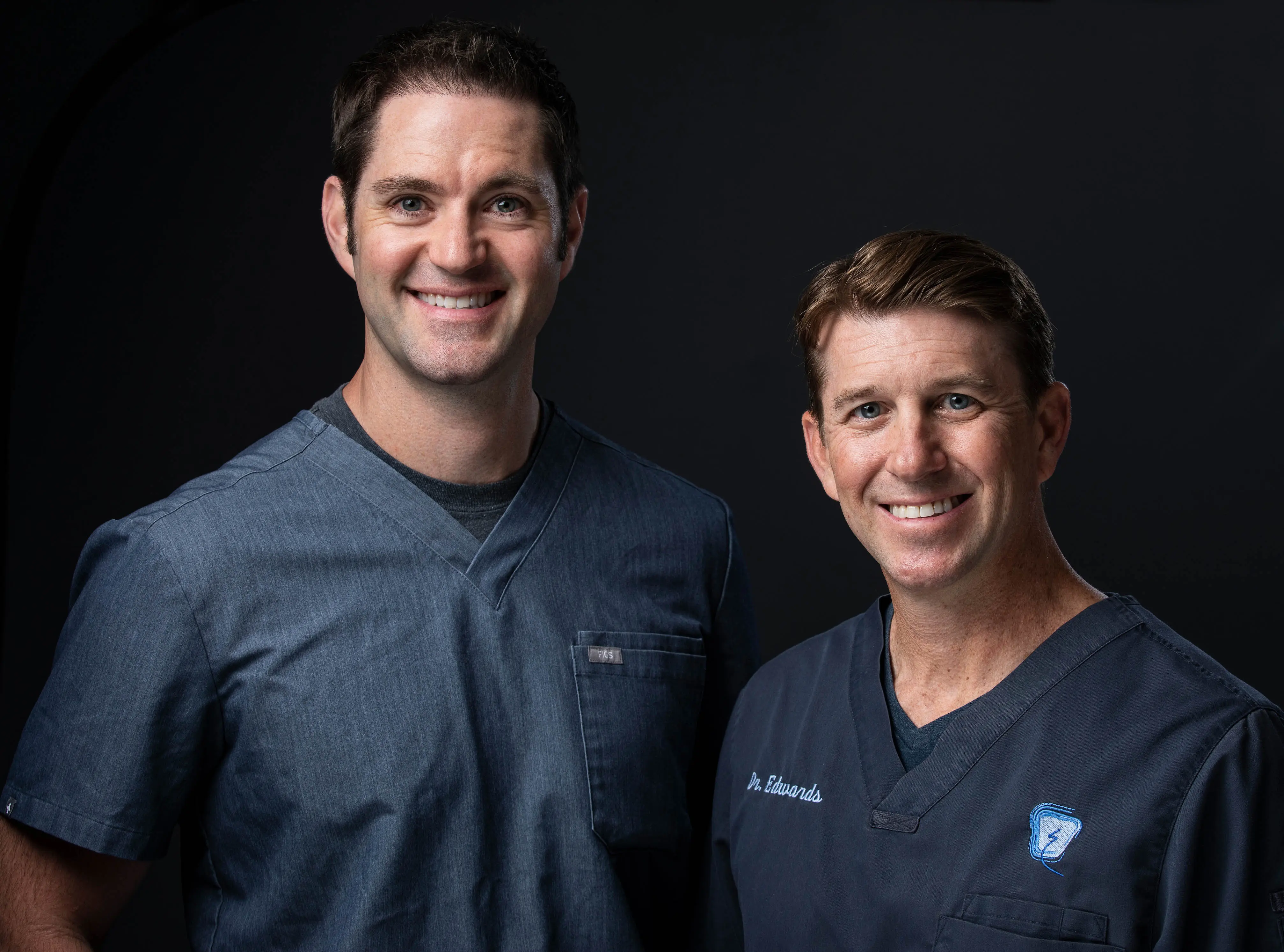
Dedication to providing the best periodontal care to Indianapolis and Fishers isn't just something Drs. Edwards and Christman talk about. They have gone above and beyond what most periodontists do to master his field of work. They have sought out further education to bring the most promising new treatments to their patients.
What Exactly is Periodontal Disease?
Periodontal disease, or gum disease, is the result of infections and inflammation of the gums and bone that surround and support your teeth. In its early stage, called gingivitis, the gums become swollen and red, and they can bleed. In its more serious form, called periodontitis, the gums pull away from the tooth, bone can be lost, and the teeth will loosen and even fall out. Periodontal disease is mostly seen in adults. Periodontal disease and tooth decay are the two biggest threats to dental health. A recent CDC report makes these claims in the US:
- 2% of adults aged 30 years and older have some form of periodontal disease.
- Periodontal disease increases with age, 70.1% of adults 65 years and older have periodontal disease.
What Causes Periodontal Disease or Gum Disease?
There are millions of bacteria in our mouths every day. If not kept in check with daily brushing and flossing these bacteria will infect the tissue surrounding the tooth, causing inflammation around the tooth leading to gum disease. When the bacteria stay on the teeth long enough, they will form a clear sticky film called plaque, which eventually hardens to tartar, also called calculus. Tartar build-up can spread below the gum line, which makes the teeth harder to clean. At this point only a dental health professional such as Implant Dentistry and Periodontics can remove the tartar and stop the periodontal disease process.

At Implant Dentistry and Periodontics, we offer a wide range of periodontal and dental implant services. Our caring and compassionate team has one collective priority and that is your smile.
Contact Our Team Today
Why Should You Get a Periodontal Exam?
All adults should thoroughly assess the state of their periodontal health to receive accurate information about the health of their mouths.
If you have one or more of the following it is a warning sign for gum disease:
- Bad breath or a bad taste that will not go away
- Your gums are red or swollen gums
- The gums are tender or bleeding
- It is painful to chew
- You can feel loose teeth
- Your teeth have become sensitive teeth
- Your gums have pulled away from your teeth
- Any change in the way your teeth fit together when you bite
- Any change in the fit of partial dentures
By addressing your oral health every six months as advised, both you and Implant Dentistry and Periodontics will know the history of your mouth and what is healthy, and we will be better able to notice any conditions, such as periodontal disease, that may need additional treatment.
Research has shown, there is an association between periodontal disease and other chronic inflammatory conditions, such as cardiovascular disease, respiratory disease, and diabetes. It is especially important for this reason to treat any inflammation that causes periodontal disease as soon as possible to ensure that your entire body stays healthy.
What is a periodontal exam?
A Periodontal Examination is a way to assess your periodontal or gum health by examining:
- Your teeth
- Your plaque
- Your gums
- Your bite
- Your bone structures
- Your risk factors
When the team at Implant Dentistry and Periodontics performs this evaluation, we will look at these six areas to determine the state of your periodontal health.
How is the exam performed?
The exam consists of the focus points listed above. One key component is what we will call your “pocket depths.” We will explain this in more detail prior to your exam, but these numbers allow us to diagnose if there is any infection or tissue loss around your teeth. These numbers help us determine what treatment plan is best suited for your individual needs.
State of the Art Technology
For Advanced Periodontics
Offering the best periodontal care in the world requires the most advanced technology in the world. Drs. Edwards and Christman are always in search of new ways to provide patients with better results and do it in a way that minimizes pain and recovery time. They are also happy to take up technologies that make it easier to communicate with patients and allow us to do our jobs in more environmentally friendly ways.
Good Oral Hygiene Leads to Good Overall Health
Our goal is to keep those pocket depths at 3 millimeters or less for you along with healthy gum tissue. Your gums should never bleed and that is a crucial sign of a healthy state. Try your best to brush with an electric toothbrush because these are programmed at two minutes. Also floss daily. Other suggestions to improve your home care for your mouth are interproximal cleaners and water picks. Together with your consistent hard work at home and our regular cleanings, exams, and periodontal evaluations, we together can keep your mouth healthy!
Earning your Trust with High Quality Periodontal Care
When you schedule a periodontal exam with our thorough staff at Implant Dentistry and Periodontics, you will be impressed by the high degree of our professionalism and that we are a team who has the most advanced dental technology at our disposal in our clinic. We pride ourselves in being conscientious because we understand how different and unique each situation really is . We are also detail orientated in developing your personalized treatments, to ensure success what works for your desires and budget. Our entire team focuses on bringing the value back into your personal asset, your healthy smile, so every procedure we perform for you is with your best interests and oral health in mind.
At Implant Dentistry and Periodontics, our clinic has a relaxing atmosphere, and we want you to be confident with our abilities and services. Scheduling an appointment for a periodontal exam is a beneficial first step towards being proactive in your oral health and regaining your healthy smile. To schedule an appointment, call our Indianapolis office, 8801 North Meridian St., Suite 103, Indianapolis, at 317-574-0600 or our Fishers office, 9885 E. 116th St, Suite 300, Fishers, at 317-842-2273.